
Dark cladding is easy to choose and hard to specify. The material list is short; the ways to get it wrong are not.
Here is how the main options actually behave once they are on a building in Australian conditions.
Charred timber (shou sugi ban)
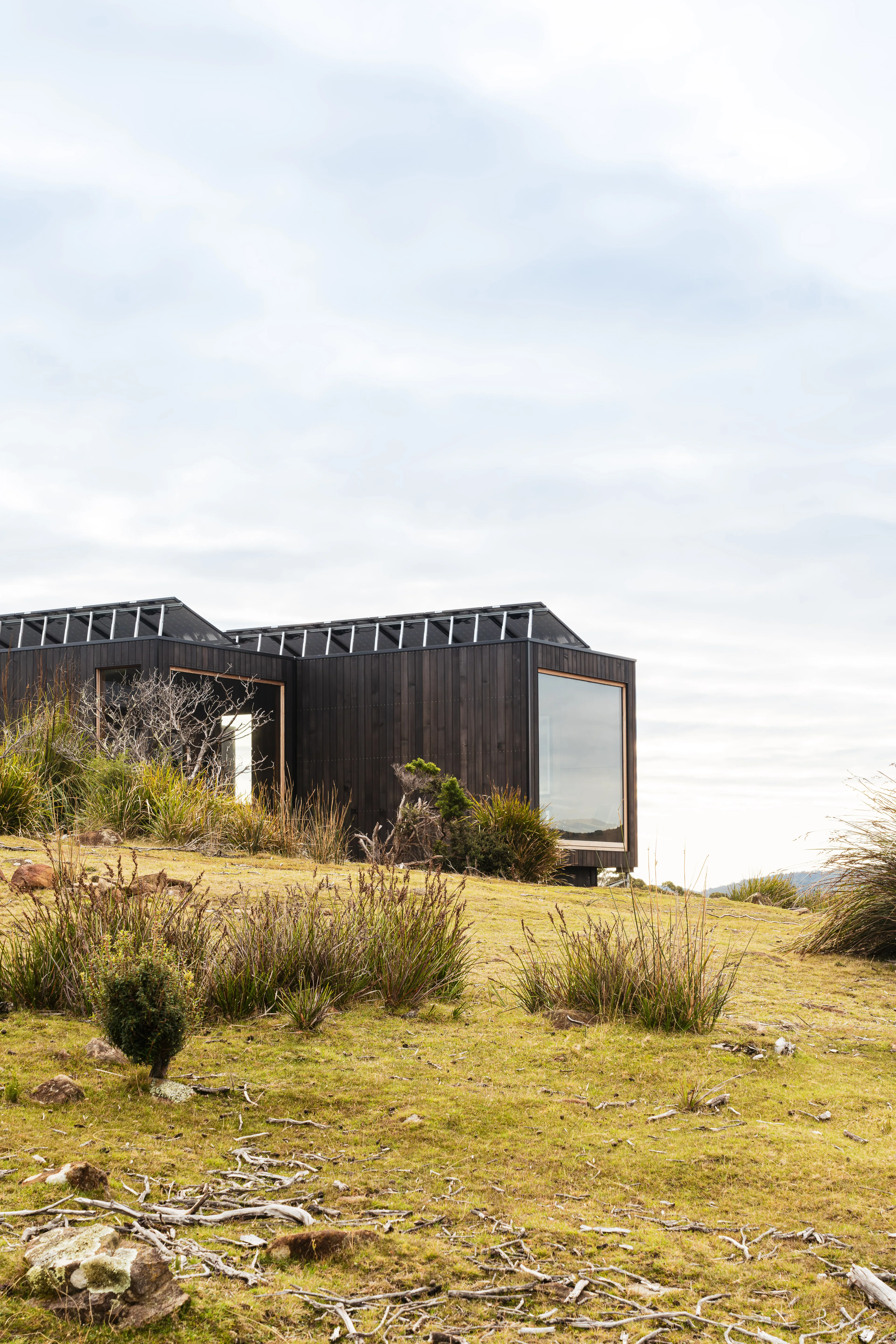
The Japanese technique of burning the timber surface to a carbon layer. It resists rot, insects and further ignition, and the colour is in the timber rather than a film on top of it.
Where it excels: exposed and coastal sites. It was developed as a weathering technique, not a fashion, and it ages more gracefully than almost anything else — it softens rather than degrades.
What to know: the depth of the char decides the character, from a fine matte grey-black to a heavily alligatored texture. It sheds a little carbon early on, so it wants care where people brush against it. Not every species chars equally; the timber has to be chosen for it.
We used charred timber at Standup Point Camp on the Tasman Peninsula, where the site is fully exposed and there is nobody nearby to maintain anything.
Dark-stained hardwoods
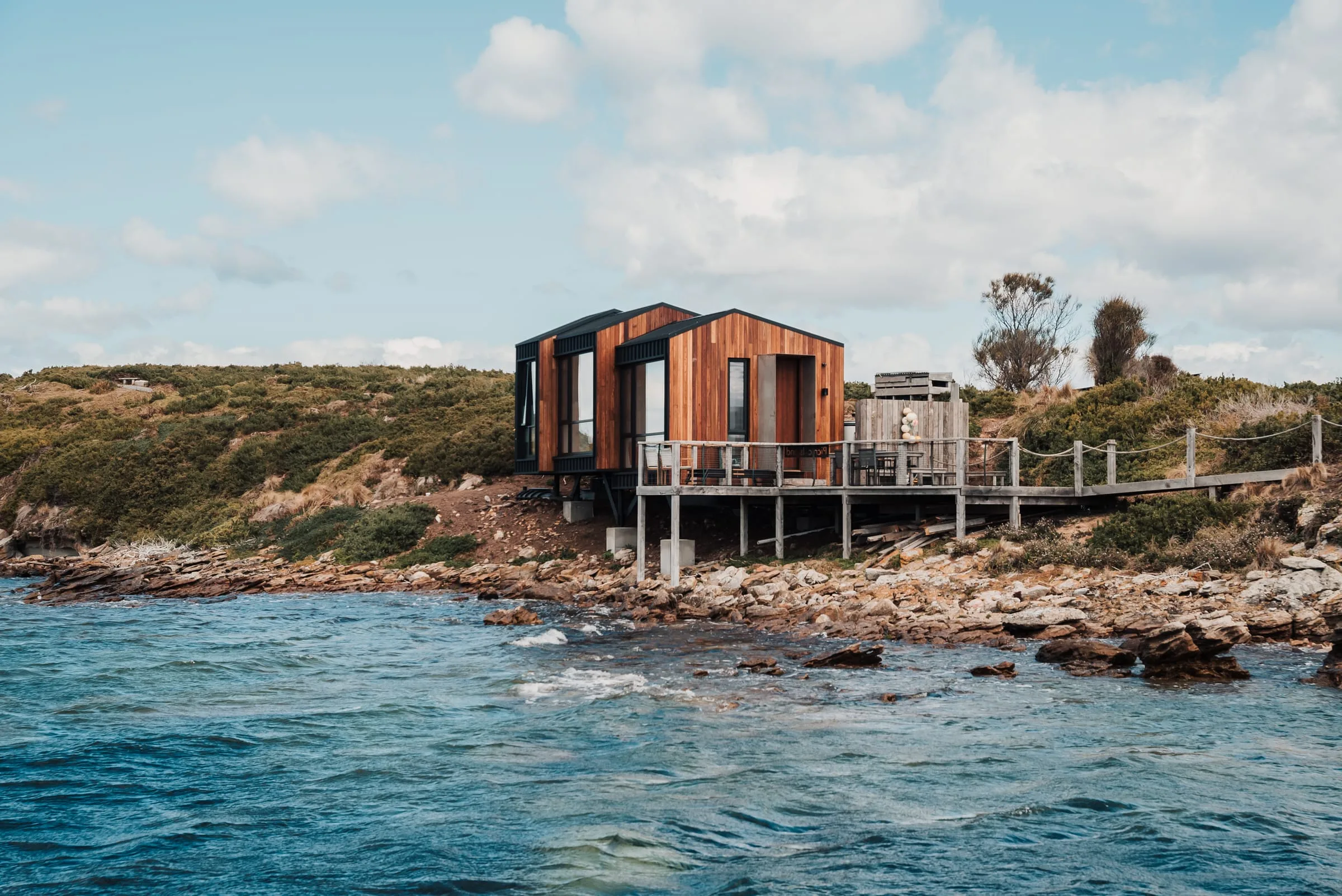
Blackbutt, ironbark and spotted gum stained dark keep the natural grain while dropping the tone into the Darkitecture range. The HQ uses Australian spotted gum this way, and Picnic Island leans on durable coastal timber throughout.
Where it excels: sheltered elevations, entries, soffits — anywhere the warmth of visible grain earns its place against harder materials.
What to know: it is a maintained finish. Stain on a fully exposed north or west elevation will need attention on a cycle, and pretending otherwise is how people end up disappointed at year six. Put it where it is protected, or accept the maintenance honestly.
Blackened and coated metal
Powder-coated aluminium and steel, and patinating metals that develop character rather than degrade.
Where it excels: precise, sharp-edged architecture. Metal holds a line no timber can, which matters when the whole composition depends on a crisp reveal.
What to know: coating grade is everything. A standard powder coat in a coastal or high-UV location will chalk. Specify a coating rated for the actual exposure, and marine-grade fixings — the fixings usually fail long before the sheet does.
Dark metal also moves with heat. Expansion allowance and fixing pattern have to be right or the facade will oil-can and telegraph every fastener.
Fibre cement
Through-coloured or coated fibre cement — Axon, Barestone and similar — is the workhorse. We used Barestone graphite in the Waverley bathroom.
Where it excels: bushfire-rated sites, larger elevations, and projects where the budget needs to go into detailing rather than material.
What to know: it lives or dies on its junctions. Cavity closers, expansion joints and sheet setout are the whole game — a bad joint on a black wall is visible from the street.
The failure that is actually common
It is almost never the substrate. It is the coating, and it is the detailing.
- Cheap dark coatings chalk and shift colour under high UV
- Fixings corrode before the cladding does, particularly within sight of salt water
- Cavities get bridged or blocked, so the wall cannot shed heat or dry
- Expansion is not allowed for, so dark metal ripples in the first hot summer
None of these are colour problems. They are specification problems that a dark building makes impossible to hide — which is exactly why we work this way. A black wall is an honest wall.
How the choice gets made
Material selection is not a finishing decision here; it happens at the Material, and gets locked into the Blackprint so the price is real and the site has nothing left to improvise.
The site decides most of it. Exposure, BAL rating, orientation and how close the nearest salt water is will narrow four options to one fairly quickly. See the Elements for the full palette, or read do dark houses get hot for the thermal side of the same question.